Last Updated: November 22, 2026
Quick Summary
In Hawaii, an uninsured driver accident claim usually runs through your own policy, using uninsured motorist (UM) or underinsured motorist (UIM) coverage, rather than the at-fault driver’s insurer. Hawaii’s no-fault system generally pays initial medical expenses and some lost income through Personal Injury Protection (PIP) regardless of fault.
- Call the police, get medical care, and document the scene with photos and witness details.
- Notify your own insurer as soon as possible and provide the police report and medical records.
- Do not give a recorded statement to any insurer before you understand your rights.
- Your UM or UIM coverage can be the main source of recovery when the other driver has no insurance.
- Review any settlement offer against your actual medical costs and lost income before accepting it.
Table of Contents
- How Much Compensation Can You Recover After an Uninsured Driver Crash in Hawaii?
- What to Do After an Accident With an Uninsured Driver
- Hawaii’s No-Fault System and How PIP Pays Initial Medical Expenses
- How to File an Uninsured Motorist Claim Step by Step
- Hawaii Uninsured Motorist Claim Rules: UM, UIM and Policy Limits
- Settling Your Uninsured Driver Accident Claim: Risks and Documentation
- Booking Your Free Consultation With Cummings Law
- Frequently Asked Questions
Hawaii drivers who are hit by someone without insurance face a hard question: who pays for the medical bills and lost wages in an uninsured driver accident claim? Cummings Law helps injured residents answer that question and pursue the compensation they may be owed. The short answer is that a claim usually runs through your own policy, not the at-fault driver’s, and the steps you take in the first days can decide how much you recover.
How Much Compensation Can You Recover After an Uninsured Driver Crash in Hawaii?
The amount you can recover depends on your injuries, your medical costs, your lost income, and the coverage you already carry. Nationally, the Insurance Information Institute reports that 15.4% of U.S. motorists were uninsured in 2023, citing the Insurance Research Council (Insurance Information Institute summary of the 2025 Insurance Research Council study). That means the problem is common, and many injured people end up relying on their own coverage.
Recovery often falls into a few categories:
- Medical bills, including treatment and rehabilitation
- Lost wages and reduced earning ability
- Pain and suffering
- Property damage to your vehicle
Your own policy may include uninsured motorist (UM) or underinsured motorist (UIM) coverage. Those benefits can be the main source of recovery when the other driver has no insurance.
What to Do After an Accident With an Uninsured Driver
Start by protecting your health and your claim. Call the police, get medical care even if you feel fine, and document the scene.
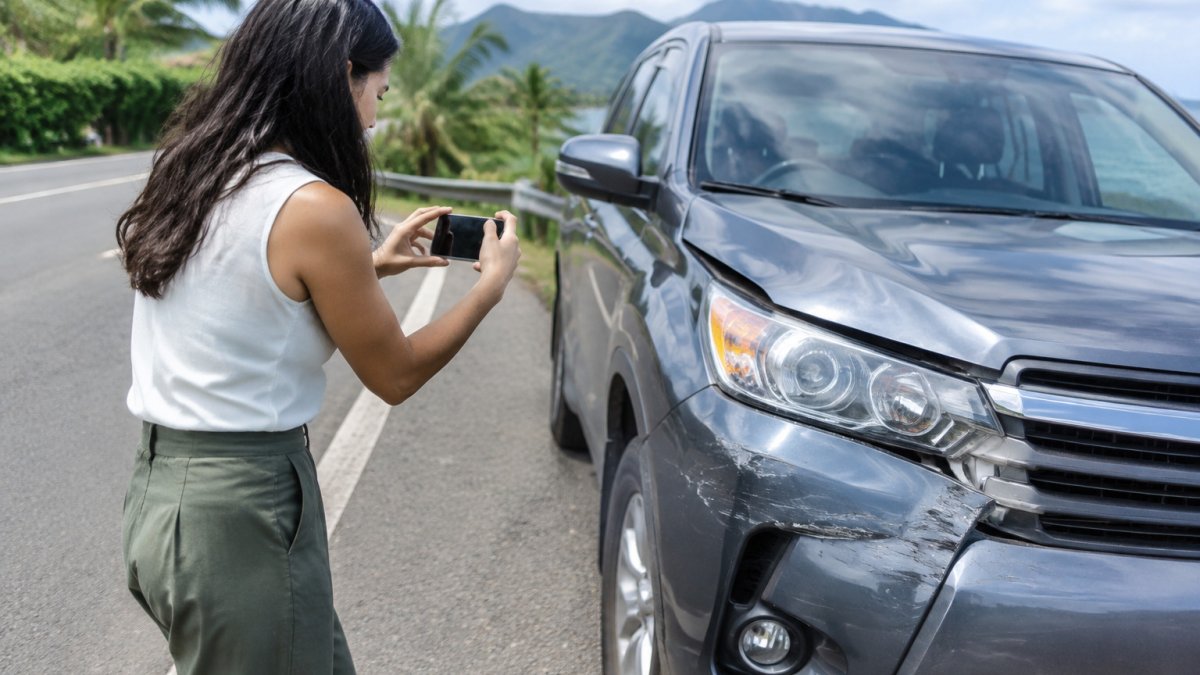
Useful steps include:
- Take photos of both vehicles, the road, and any visible injuries
- Get the other driver’s name, address, and license plate number
- Collect names and phone numbers of any witnesses
- Keep every medical record and receipt
Watch out: Do not give a recorded statement to any insurer before you understand your rights. Saying the wrong thing early can affect your claim.
A driver standing beside a parked car on a Hawaii roadside, photographing the damage with a smartphone under overcast light. | section:What to Do After an Accident With an Uninsured Driver
Hawaii’s No-Fault System and How PIP Pays Initial Medical Expenses
Hawaii uses a no-fault system for auto injury claims. Personal Injury Protection (PIP) benefits generally pay initial medical expenses and some lost income regardless of who caused the crash. Confirm the current rules with the Hawaii Insurance Division.
PIP is a useful starting point, but it has limits. Serious injuries may require claims beyond the no-fault system. Check your own policy and the official state resources to confirm the current benefit amounts, since these figures can change.
How to File an Uninsured Motorist Claim Step by Step
An uninsured motorist claim is made under your own policy. The general process looks like this:
- Notify your insurer of the accident as soon as possible
- Provide the police report and your medical records
- Explain the other driver’s lack of insurance
- Cooperate with the insurer’s investigation
- Review any settlement offer before you accept it
Your insurer must be told promptly. Missing a deadline can put your claim at risk, so confirm the filing requirements in writing. You can learn more in our guide to Hawaii uninsured motorist claim deadlines.
The Assigned Claims Program When You Have No Applicable Insurance
Some people have no insurance that applies to a crash, such as a pedestrian or a visitor. Hawaii has an Assigned Claims Program for certain situations like this. Eligibility rules and the application process have specific requirements, so verify them with the official program before you apply.
The filing process follows a clear sequence, and each step has a timing point worth tracking.
| Step | What to do | Timing |
|---|---|---|
| 1 | Notify your insurer of the accident | As soon as possible |
| 2 | Provide the police report and medical records | Promptly after the crash |
| 3 | Explain the other driver’s lack of insurance | During the initial claim |
| 4 | Cooperate with the insurer’s investigation | Throughout the claim |
| 5 | Review any settlement offer | Before you accept it |
Hawaii Uninsured Motorist Claim Rules: UM, UIM and Policy Limits
UM and UIM coverage are the two policy-based paths that most injured people rely on when the at-fault driver has no insurance or too little of it. Understanding how they interact with Hawaii’s no-fault system is what separates a claim that gets paid from one that gets denied on a technicality.
UM versus UIM in plain terms
Uninsured motorist (UM) coverage responds when the at-fault driver has no liability insurance at all, no policy, a canceled policy, or a hit-and-run driver who is never identified. Underinsured motorist (UIM) coverage responds when the at-fault driver does have insurance, but the policy limits are too low to cover your losses. In both cases the claim is made against your own insurer, and your insurer stands in the shoes of the at-fault driver for purposes of the claim.
How the no-fault threshold gates a UM/UIM claim
Hawaii’s no-fault system limits when an injured person can step outside PIP and pursue a liability-type claim. The threshold depends on the statutory definition of a serious injury. The exact definition should be confirmed against the current Hawaii statute and your policy, because policy language can add its own conditions.
A plain-language decision path looks like this:
- Did PIP pay your initial medical bills and some lost income? If yes, you are still inside the no-fault system for those benefits.
- Does your injury meet the serious-injury threshold under the current Hawaii statute? If no, your recovery may be limited to PIP and you may not be able to bring a UM/UIM claim for pain and suffering.
- If the threshold is met, is the at-fault driver uninsured or underinsured? If uninsured, look to UM. If underinsured, look to UIM.
- Do your UM/UIM limits exceed the at-fault driver’s limits? How UIM pays out depends on your policy language and Hawaii law, so review your policy to confirm how the gap is calculated.
- Does your policy or a household policy add stacking or higher limits? Review every declarations page in the household before assuming a single limit applies.
How limits are actually calculated
Policy limits cap what your insurer will pay under that coverage. A common point of confusion is that UIM does not simply add to the at-fault driver’s policy, it usually fills the difference up to your UIM limit. Stacking, combining limits from multiple vehicles or policies, depends on the language of each policy and on applicable state law. Confirm with your insurer and the official Hawaii source.
Exclusions and policy-specific limits to check
Coverage details vary widely, and a policy review early in the case is worth the time. Items worth confirming on the declarations page and in the policy jacket include:
- Whether UM/UIM is listed as bodily injury, property damage, or both
- Whether the policy covers the vehicle you were in at the time of the crash
- Whether a household policy provides additional UM/UIM limits
- Whether the policy defines an uninsured vehicle to include hit-and-run and phantom vehicles
- Whether any exclusion applies because of a household member, a company vehicle, or a rideshare arrangement
- Whether the policy requires prompt notice and a recorded statement, and what the consequences of delay are
Watch out: A UM/UIM claim is not automatically available just because the other driver was uninsured. If the serious-injury threshold is not met, or if the policy excludes the vehicle or the driver, the claim can be denied even where coverage exists on paper. Confirm both the threshold and the policy language before assuming a UM/UIM payout is available.
Settling Your Uninsured Driver Accident Claim: Risks and Documentation
Insurers sometimes make early settlement offers that do not reflect the full value of a claim. Before you accept, compare the offer against your actual medical costs, lost income, and future care needs.
Keep organized records of:
- All medical bills and treatment notes
- Pay stubs or employer letters showing lost wages
- Insurer correspondence, including dates and names
- Photos and repair estimates for your vehicle
A settlement usually ends the claim, so accept only after you understand what you are giving up.
Booking Your Free Consultation With Cummings Law
Cummings Law represents injured clients on a contingency basis, so there are no upfront attorneys’ fees or court fees until your case is resolved. Founder and lead attorney Brian Cummings has obtained over $47,000,000 for clients in recent years, including settlements of $15 million, $2.75 million, $10 million, and $1.995 million. Every case is different, and past results do not predict the outcome of any particular case.
To understand your options, call for a consultation with our team. We will review your coverage, explain your deadlines, and outline next steps.
Frequently Asked Questions
Do I have to pay if I get hit by an uninsured driver?
Usually not out of pocket for initial medical bills. Hawaii is a no-fault state, so your own Personal Injury Protection (PIP) coverage pays initial medical expenses and certain lost income regardless of who caused the crash. If you carry uninsured motorist (UM) coverage, it can also help with damages beyond PIP. Coverage amounts and limits vary by policy, so review your declarations page or ask your insurer to confirm what applies to you.
Can I use uninsured motorist coverage if the at-fault driver has no insurance?
Yes. Uninsured motorist coverage is designed for exactly this situation, when the at-fault driver has no liability insurance. Hawaii’s no-fault framework means you first look to your own PIP benefits for initial medical expenses, and UM coverage can then address damages that exceed PIP or that fall outside the no-fault system. Filing a claim usually requires prompt notice to your insurer and documentation of your injuries and losses.
Is Hawaii a no-fault state for accidents?
Yes. Hawaii uses a no-fault system in which each driver’s own Personal Injury Protection (PIP) coverage pays initial medical expenses and certain lost wages after a motor vehicle accident, regardless of fault. Rights to sue an at-fault driver for pain and suffering are limited and depend on the seriousness of the injury. Because thresholds and benefit amounts are set by state law, confirm current requirements with the Hawaii Insurance Division or a qualified attorney.
Will my insurance rates go up after an uninsured motorist claim?
A claim can affect your premiums depending on your insurer’s rating practices and your overall claims history, and rate changes are not guaranteed either way. Because the other driver was at fault, many insurers treat such claims differently from at-fault claims, but policies vary. Ask your insurer directly how a UM or PIP claim would be handled on your policy before you file, and keep records of all communications.