Table of Contents
- Why Motorcycle Accident Evidence Collection Matters
- Safety First: Securing the Scene Before You Collect
- Taking Motorcycle Accident Scene Photos
- Building Your Motorcycle Accident Evidence Checklist
- Collecting Motorcycle Accident Witness Statements
- Preserving Motorcycle Accident Evidence After the Scene
- What to Do If You Cannot Collect Evidence at the Scene
- Next Steps: Protecting Your Claim and Your Rights
- Frequently Asked Questions
Last Updated: October 14, 2026
Why Motorcycle Accident Evidence Collection Matters
When a motorcycle accident happens, the first instinct is to get medical help or call the police. At Cummings Law, we understand the importance of preserving key evidence. (Source: National Highway Traffic Safety Administration’s 2024 data)
The numbers are stark. According to National Highway Traffic Safety Administration motorcycle safety data, motorcyclists accounted for 16.2% of all traffic fatalities in 2024, despite representing just 3% of registered vehicles.
Motorcycle accident evidence collection isn’t just about winning a case. It’s about protecting yourself when the other driver’s insurance company claims the accident was your fault.
The evidence that matters most vanishes fastest: road debris gets swept away, skid marks fade, witnesses forget details, and medical records get filed away.
Safety First: Securing the Scene Before You Collect
Before you take a single photo, make sure you’re safe.
If your motorcycle is still in traffic, move it to the shoulder if you can do so without worsening your injuries, and turn on hazard lights. If you’re injured and can’t move, stay put and wait for responders.
Call 911 immediately if anyone is injured, before collecting evidence. Police document the scene officially, which carries weight in court.
Once you’re safe, take a breath, shock and pain are normal, but the next 30 minutes determine what evidence survives.
Key priorities before you start collecting:
- Check yourself and passengers for injuries
- Move to a safe location away from traffic if possible
- Call 911 if anyone is hurt
- Turn on hazard lights to warn other drivers
- Do not admit fault or apologize for the accident
If you’re too injured to collect evidence yourself, ask a bystander to help. Show them what to photograph and give them your phone.
Taking Motorcycle Accident Scene Photos
Photography is your most powerful evidence tool: a photo proves what happened and doesn’t forget.
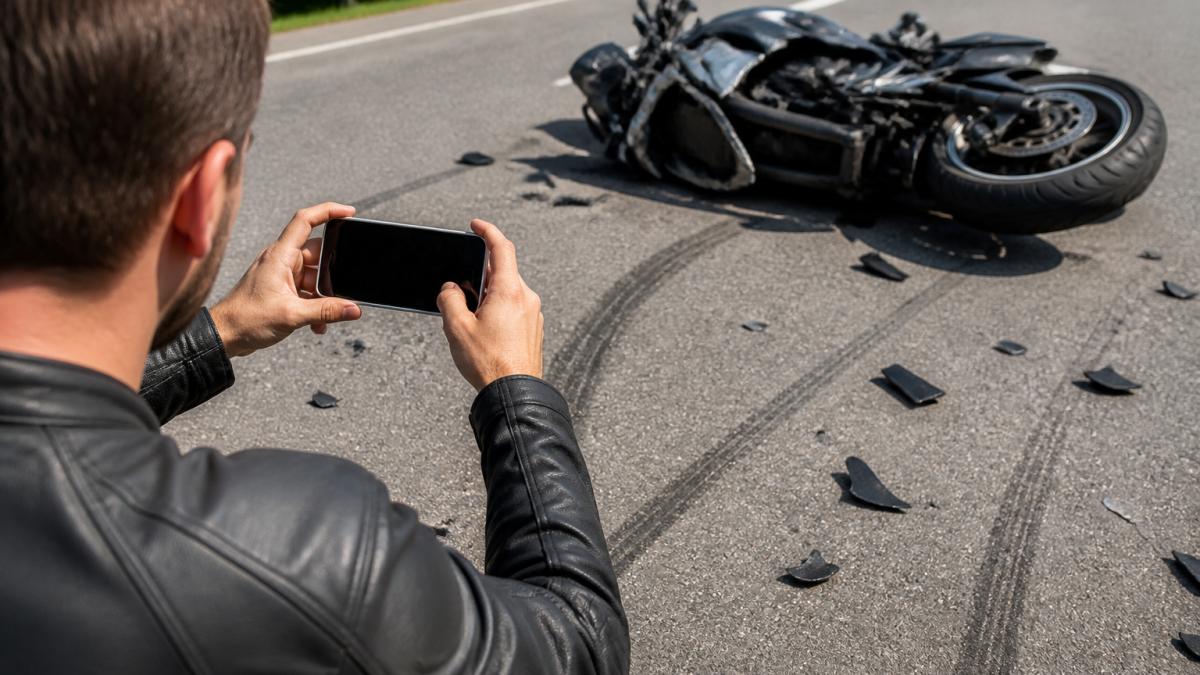
Start with wide shots of the entire scene, then move closer, photographing from multiple angles. Get the road, vehicles, debris, and surroundings, aim for at least 20-30 photos.
Photograph the Motorcycle and Damage
Your motorcycle tells the story of impact. Every dent, scratch, and broken part shows where and how the collision happened.
Photograph the entire motorcycle from multiple angles, front, rear, both sides, and above, plus close-ups of every damaged area: shattered windscreen, bent handlebars, cracked fairings.
Document fluid leaks and tire damage or deflation; leaking oil or coolant proves impact force.
Photograph your helmet and gear too, even if they look fine, cracks, scuffs, and damage show impact points and help reconstruct what happened.
Motorcycle damage to photograph:
- Frame damage or bending
- Wheel damage or deflation
- Handlebars, mirrors, and controls
- Fairings, bodywork, and paint transfer
- Seat and rear structure
- Undercarriage and engine damage
- Fluid leaks or spills
- Helmet cracks, scuffs, or impact marks
- Jacket, pants, gloves, and boots for tears or abrasion
Document Road Conditions and Visibility
The road itself is evidence. Photograph the surface where the accident occurred, looking for potholes, gravel, oil, water, or debris that may have caused loss of control.
Photograph skid marks from multiple angles and distances, including a reference object like a coin or your hand to show scale, they reveal where the motorcycle locked up and how far it traveled.
Document weather and visibility: wet pavement, darkness at dawn or dusk, trees blocking the sun, or broken or dim street lights.
Photograph road signs and signals at the intersection, plus the view from where you and the other driver were traveling.
Road evidence to photograph:
- Skid marks and their length
- Road surface conditions (wet, dry, gravel, potholes)
- Debris scattered across the road
- Street signs and traffic signals
- Road markings and lane lines
- Lighting conditions and street lights
- Weather conditions (rain, fog, glare)
- Visibility from both directions
- Intersection layout and sight lines
Building Your Motorcycle Accident Evidence Checklist
A checklist keeps you organized when you’re stressed. Print it and keep it in your jacket pocket.
The first minutes after an accident are chaos. A checklist ensures you don’t forget critical steps. Use it at the scene. Use it again at home to verify you collected everything.
| Evidence Type | What to Collect | Status |
|---|---|---|
| Scene photos | 20-30 wide and close-up photos of damage, road, and conditions | ☐ |
| Vehicle information | Other driver’s name, phone, address, license, plate, insurance | ☐ |
| Police report | Report number, officer name, and contact information | ☐ |
| Witness statements | Names, phone numbers, email addresses of all eyewitnesses | ☐ |
| Medical records | Hospital visit documentation, X-rays, treatment timeline | ☐ |
| Helmet and gear | Photographs and physical preservation of protective equipment | ☐ |
| Skid marks | Photos showing length, direction, and reference scale | ☐ |
| Road debris | Photos of scattered parts, fluid, and road damage | ☐ |
Driver and Insurance Information
Get the other driver’s full name, phone number, address, driver’s license number and state, license plate number, VIN, and insurance company name, policy number, and agent contact.
Ask calmly and directly, and write it down rather than relying on memory. If the other driver refuses or becomes hostile, note that and wait for police.
Take a photo of their driver’s license and insurance card while you have access.
If multiple vehicles are involved, collect information from each. If the other driver leaves before police arrive, give police their plate number and any description you remember.
Police Report and Accident Documentation
The police report is official documentation that carries weight in court. Get the officer’s name, badge number, and report number before they leave.
Ask when the report will be available and how to obtain a copy, most departments post reports online within 48 hours, while some require a written request.
The police report should include:
- Officer observations about the scene
- Statements from both drivers
- Witness statements
- Citations or violations cited
- Diagram of the accident scene
- Weather and road conditions
Request a copy as soon as it’s available. Forward it to Cummings Law immediately.
Collecting Motorcycle Accident Witness Statements
Witnesses are gold: their statements corroborate your version of events.
Find every witness and talk to them immediately, while their memory is fresh. Ask them to describe what they saw, and listen without correcting them or suggesting details.
Get their name, phone number, and email address, and ask if they’d speak with your attorney later. If someone hesitates, don’t push, you have their contact information.
Take a photo of their driver’s license if they’re willing; if they refuse, their name and number are enough.
If a witness saw the accident from a business or home, ask if security cameras recorded it.
Witness information to collect:
- Full name and phone number
- Email address
- Home or business address
- What they saw and when
- Their location during the accident
- Whether they’d speak with your attorney
- Any security camera footage they know of
Preserving Motorcycle Accident Evidence After the Scene
Evidence degrades. Helmets crack further. Clothing gets washed. Medical records get filed away. Memories fade. The work doesn’t end at the scene.
Protecting Your Helmet, Gear, and Clothing
Your helmet and protective gear are physical evidence showing impact force and injury patterns. Do not repair or replace them until your case is resolved.
Store your helmet in a dry place, don’t wash it or sand down cracks, and photograph all damage in detail, including interior padding or foam.
Your jacket, pants, gloves, and boots are evidence.
Take multiple photos of each piece of gear from different angles, focusing on damage, tears, and abrasion marks that show where your body made contact.
If an insurance adjuster or investigator asks to see your gear, copy your photos first, let them examine it, but retain possession.
Maintaining Your Medical Records and Treatment Timeline
Your injuries are the most important evidence. Document everything.
Keep every medical receipt, prescription, X-ray, lab result, physical therapy bill, and doctor’s note.
Create a timeline noting each visit’s date, treatment, and doctor’s comments, plus when pain improved or worsened and how the injury affected daily life.
If you miss work, document it with pay stubs showing lost wages and employer emails confirming time off.
Photograph visible injuries, bruises, scars, swelling, over time as they heal to show severity.
Request copies of all medical records, emergency room, hospital stay, and follow-up visits, and forward them to Cummings Law.
Digital Evidence and Chain of Custody
Digital evidence is fragile: a deleted photo or lost text message is gone forever, so protect your digital records.
Back up all accident scene photos and videos to cloud storage like Google Drive, iCloud, or OneDrive, plus a copy on your computer.
Save text messages and emails related to the accident. Screenshot conversations with the other driver or their insurance company.
Save dash cam footage immediately without editing or trimming, and back up the original file to cloud storage.
Create a document listing all evidence collected, the dates, and where it’s stored, this chain of custody proves the evidence hasn’t been tampered with.
What to Do If You Cannot Collect Evidence at the Scene
This doesn’t mean you’ve lost your case. It means you collect evidence differently.
Request the officer’s accident scene photos from the police department; police photographs are official and carry legal weight.
Contact nearby property owners or businesses to ask if security cameras recorded the collision and request the footage.
Talk to witnesses again. Even weeks later, witness statements are valuable. Written statements from witnesses carry more weight than verbal ones.
Request medical records from every provider who treated you to document your injuries and prove causation.
If you cannot collect evidence yourself, contact Cummings Law. We can help ensure your case has the evidence it needs.
Next Steps: Protecting Your Claim and Your Rights
Collecting evidence is step one. What you do with it matters equally.
Forward all evidence to Cummings Law immediately, don’t wait or organize it perfectly. We’ll organize it and ensure nothing is missed.
Do not communicate directly with the other driver’s insurance company without legal representation.
Do not post about the accident on social media or discuss it on public platforms.
Do not accept any settlement offer without speaking to Cummings Law first.
Evidence preservation timeline:
- Day 1: Photograph scene, collect witness statements, call police
- Day 2-7: Obtain police report, collect medical records, preserve gear
- Week 2-4: Request security footage, send evidence to Cummings Law
- Ongoing: Document medical treatment, maintain timeline
The work you do in the hours and days after an accident determines your legal outcome.
Cummings Law has recovered over $47 million for injured clients.
If you’ve been injured in a motorcycle accident, contact Cummings Law for a free consultation. We’ll review the evidence you’ve collected.
Frequently Asked Questions
What evidence should I collect immediately after a motorcycle accident?
Collect photographs of the motorcycle damage, vehicle positions, skid marks, and road conditions from multiple angles. Get the other driver’s license, insurance card, and vehicle information. Record witness names and phone numbers, note the time and weather, and call police to file an accident report. If injured, seek medical attention and keep all documentation. Document your injuries with photos and preserve your helmet and riding gear without cleaning or altering them.
How do I preserve motorcycle accident evidence properly?
Store your helmet, clothing, and protective gear in a safe, dry place without washing or repairing them, they are evidence of impact and injury severity. Keep all medical records, X-rays, and treatment timelines in one folder. Save all photographs and video footage on multiple devices or cloud storage to prevent loss. Maintain the police report number and any correspondence with insurance companies. Do not discard damaged motorcycle parts before an attorney or insurance adjuster can examine them.
Why is a motorcycle accident evidence checklist important for my claim?
A thorough motorcycle accident evidence checklist ensures you capture all details that support your case while memory is fresh and evidence is accessible. Insurance companies and courts rely on documented scene conditions, witness accounts, medical records, and physical evidence to determine fault and damages. Missing critical evidence weakens your position and can reduce settlement offers. An organized checklist prevents costly oversights that could affect your compensation.
Can I collect motorcycle accident witness statements myself, or should a lawyer do it?
You can collect basic witness information at the scene, names, phone numbers, and brief accounts of what they saw. Witness statements are powerful evidence of fault and liability. If you delay or wait too long, witnesses may move, forget details, or become unavailable, so capture their contact information immediately at the scene.