Table of Contents
- Step 1: Secure the Scene and Check for Injuries
- Step 2: Move to Safety and Exchange Driver Information
- Step 3: Documenting Accident Scene Evidence That Supports Your Claim
- Step 4: Report the Accident to Police and File the Required Report
- Step 5: Seek Medical Attention and Keep Every Record
- Step 6: How Hawaii No-Fault Insurance Laws Shape Your Claim
- Step 7: The Statute of Limitations for Car Accidents in Hawaii
- Conclusion: Protect Your Rights After a Crash
- Frequently Asked Questions
Last Updated: September 27, 2026
Step 1: Secure the Scene and Check for Injuries
The 7 steps to take after a car accident in Hawaii begin with one priority: safety. According to the Honolulu Police Department, traffic fatalities dropped significantly in 2026 compared to the same period in 2025, but officials stress that even one fatality remains a critical public safety concern.
When to Call 911 and When to Move Your Vehicle
Call 911 when there are injuries, when vehicles block traffic lanes, or when the other driver appears impaired or flees. Move your vehicle only when it’s drivable and doing so won’t cause further danger. Under Hawaii law, leaving the scene of an accident is prohibited and carries penalties including fines and license suspension.
Step 2: Move to Safety and Exchange Driver Information
Once everyone is out of harm’s way, collect the other driver’s name, phone number, address, driver’s license number, license plate, and insurance details. Ask for their policy number directly, not just the insurer’s name.
What Driver and Vehicle Details to Collect
Gather these details from every driver involved:
- Full legal name and contact information
- Driver’s license number and issuing state
- License plate number, make, model, and color
- Insurance carrier and policy number
- Vehicle identification number (VIN)
If a witness saw the crash, get their name and phone number too. Witness statements often carry more weight than either driver’s account.
Step 3: Documenting Accident Scene Evidence That Supports Your Claim
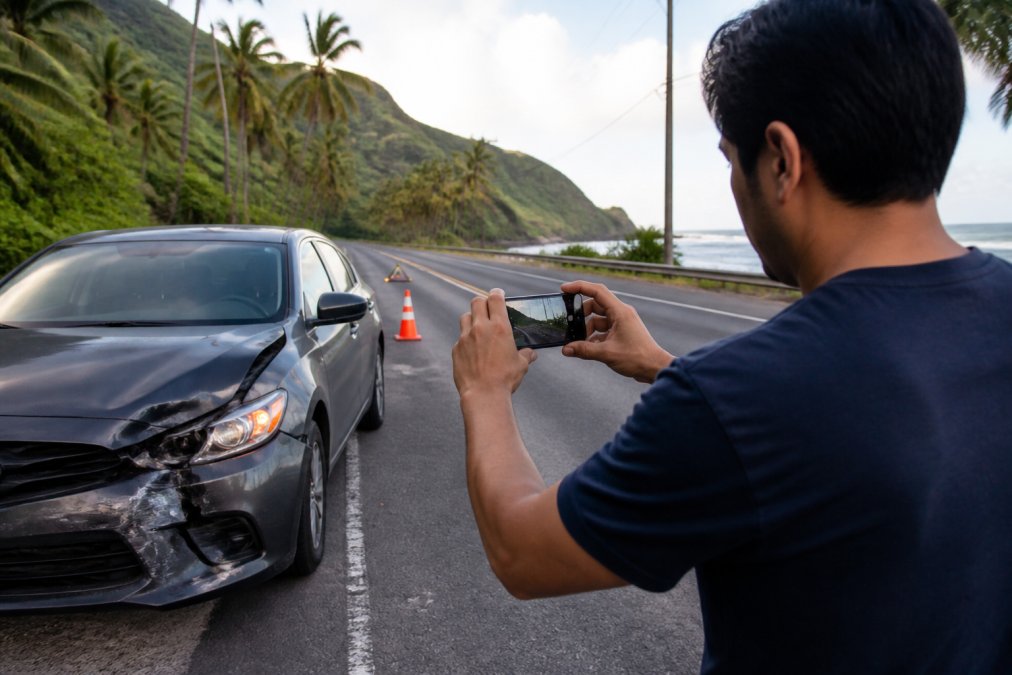
Documenting accident scene evidence is the step most drivers rush, and it’s the one that decides claims. Legal and insurance guidance now explicitly recommends photographing road conditions, traffic signals, and vehicle damage to support your claim, according to Joe Lopez Law.
Photos, Witness Statements, and Digital Evidence Preservation
Back up photos and videos the same day, before anything is deleted or overwritten. Take wide shots of the scene, close-ups of damage, and pictures of skid marks, signals, and weather. Save dashcam footage immediately and screenshot any texts about the crash.
Enable automatic cloud backup on your phone before you need it. Photos stored only on a device can be lost if the phone is damaged in the crash or replaced during repairs.
Step 4: Report the Accident to Police and File the Required Report
Filing an accident report creates the official record your insurer and any future claim will rely on. Call police to the scene when there are injuries, significant property damage, or a fault dispute. When officers respond, ask for the report number and how to request a copy, most departments release reports after a short processing window, some for a small per-page fee.
When the Law Requires You to File a Report
Hawaii law requires drivers to file a written report with the state within a set number of days when a crash causes injury, death, or property damage above a statutory dollar threshold. It goes to the state agency that maintains crash records, not your insurer, and is separate from any officer’s report.
What the Report Should Include
A complete report typically asks for:
- Date, time, and exact location of the crash
- Names, addresses, and license numbers of all drivers
- Vehicle makes, models, years, and plate numbers
- Insurance carrier and policy number for each driver
- A short narrative of how the crash happened
- Names and contact information for any witnesses
- A description of injuries and property damage
Write the narrative in plain, factual language. Do not speculate about fault, do not apologize, and do not estimate your injuries, those statements can be quoted back to you months later.
Getting a Copy of the Report
Request a copy of both the officer’s report and your own filed report, and keep the report number in your phone and a cloud folder. Insurers routinely ask for it on the first call. If the agency uses an online portal, download the PDF rather than relying on a link that may expire.
If officers do not come to the scene, you can still file your own report. Do it the same day while your memory is fresh, and keep a timestamped copy for your records.
Why the Report Matters to Your Claim
The police report is often the first document an adjuster reads, capturing the location, vehicles, stated injuries, and any citations issued. Citations for speeding, impaired driving, or running a light can strongly support your claim. If the report contains an error, a wrong lane, misspelled name, or missing witness, contact the records division promptly to submit a correction; uncorrected errors can follow the claim for months.
Hawaii Department of Transportation
Step 5: Seek Medical Attention and Keep Every Record
Seek medical attention even if you feel fine. Adrenaline masks symptoms, and some injuries, including whiplash and concussions, show up hours or days later. A medical evaluation creates a documented link between the crash and your injuries. Securing your vehicle safely off the roadway often requires professional 24-hour roadside assistance to prevent further hazards while you prioritize your immediate health assessment.
Step 6: How Hawaii No-Fault Insurance Laws Shape Your Claim
Hawaii is a no-fault state, which changes almost everything about how a car accident claim moves through the system. Under no-fault, your own auto insurer pays your accident-related medical bills and lost wages first, regardless of who caused the crash. You don’t have to prove fault or wait for the other driver’s insurer to accept responsibility.
What Personal Injury Protection (PIP) Actually Covers
Every Hawaii auto policy is required to include personal injury protection, commonly called PIP. PIP is the coverage you tap first after a crash. It typically pays for:
- Reasonable and necessary medical expenses, including emergency care, imaging, surgery, and follow-up visits
- A portion of lost wages if you miss work because of your injuries
- Replacement services, such as help with household tasks you cannot perform while recovering
- Funeral and burial expenses in fatal crashes
How PIP Interacts With Liability Coverage
PIP pays your own bills quickly, without a fault fight; liability coverage pays the other driver when you cause a crash. Because of no-fault, you generally can’t sue the at-fault driver for pain and suffering unless your injuries meet a statutory serious injury threshold or the crash falls into a recognized exception.
In a no-fault state, the first call is usually to your own insurer, not the other driver’s. Open the PIP claim immediately, delays in seeking treatment are the most common reason PIP benefits get disputed.
What to Do When the Adjuster Calls
An adjuster will contact you quickly, sometimes within hours, aiming to settle for as little as possible. A few rules:
- Give your name, policy number, and the basic facts of the crash. Nothing more.
- Do not give a recorded statement to the other driver’s insurer. You are not required to, and recorded statements are used to lock in a version of events before you know the full extent of your injuries.
- Do not sign a release or accept a settlement before you understand your diagnosis, your treatment plan, and how long your recovery will take.
- Keep a written log of every call: date, time, who you spoke with, and what was said.
Common PIP Pitfalls
Most disputes over PIP benefits come down to a handful of issues:
- Late reporting. Insurers expect prompt notice. Waiting weeks to open a PIP claim gives the adjuster an argument that the injuries were not crash-related.
- Gaps in treatment. Long gaps between medical visits are often used to argue the injury resolved or was caused by something else.
- Pre-existing conditions. If you have a prior injury to the same body part, expect the adjuster to attribute your symptoms to the old injury. Consistent, documented treatment is the best answer.
- Unclear causation. A medical record that ties your symptoms to the crash, not just to “pain”, carries far more weight.
Rental Car Accidents and Single-Car Accident Claims
Rental car accidents add a layer: your personal policy, the rental company’s coverage, and any credit card protection may all apply, and the order matters. If you declined the rental company’s coverage, your own PIP may still follow you into the rental; if you bought supplemental liability coverage, it may respond alongside your policy.
Accepting a settlement offer closes your claim permanently. If your injuries turn out to be worse than expected, you cannot reopen it for more money. Get a full medical assessment before you sign anything.
When to Bring in an Attorney
You can handle a minor, property-damage-only claim alone. Consider an attorney when:
- Your injuries are serious, permanent, or require surgery
- The at-fault driver’s insurer disputes fault
- Your PIP benefits are being denied or cut off
- You are unsure whether your injuries meet the threshold to step outside the no-fault system
- A government vehicle, a commercial truck, or a rental car is involved
Hawaii Department of Commerce and Consumer Affairs, Insurance Division
Step 7: The Statute of Limitations for Car Accidents in Hawaii
The statute of limitations for car accidents in Hawaii sets the deadline for filing a lawsuit, and missing it usually ends your right to recover through the courts. Because it’s set by statute and can shift based on your case’s facts, confirm the current timeframe with a qualified attorney or official court source before relying on any number.
Rental Car Accidents and Single-Car Accident Claims
Rental car accidents add a layer: your personal policy, the rental company’s coverage, and any credit card protection may all apply, and the order matters. A single-car accident still qualifies for PIP benefits in many cases, even without another driver involved. Both situations reward early legal guidance.
Conclusion: Protect Your Rights After a Crash
The steps above protect you in the first hours, but the months that follow decide what your case is worth. If an adjuster is pushing back or you’re unsure your claim is valued fairly, Cummings Law can help. Our firm has obtained over $47,000,000 for clients in recent years, operates on a contingency basis with no attorneys’ fees or court fees until your case is complete, and provides thorough case investigation and evidence gathering backed by founder Brian Cummings’s courtroom experience.
Frequently Asked Questions
What are the legal requirements for car accidents in Hawaii?
Under Hawaii law, you must stop immediately, provide your name, address, and insurance information to the other driver, and render reasonable assistance to anyone injured. Leaving the scene is a hit-and-run offense with fines and potential license suspension. You must also file a police report for any crash involving injury, death, or property damage above the state threshold. Hawaii no-fault insurance laws require you to notify your own insurer promptly to open a personal injury protection (PIP) claim.
Do I need to call the police for a minor car accident?
Yes, call the police for any collision that blocks traffic, involves an injury, or leaves you unsure about fault. An official police report creates a neutral record of the accident scene documentation, which helps your insurance adjuster evaluate liability. For a minor motor vehicle collision in a parking lot with no injuries, you may exchange information and file a report later, but a police report still strengthens your claim. When in doubt, call 911 and let the dispatcher decide.
How does the no-fault insurance system affect my claim?
Hawaii no-fault insurance laws require your own auto policy to pay for medical bills and lost wages through personal injury protection (PIP), regardless of who caused the crash. You cannot sue the at-fault driver for these basic economic damages unless your injuries meet the state’s serious injury threshold. PIP covers you, your passengers, and pedestrians. If you suffer serious injuries, you may step outside the no-fault system and pursue a bodily injury claim against the at-fault driver’s liability coverage.
What is the statute of limitations for car accidents in Hawaii?
Hawaii sets a statute of limitations for car accidents, meaning you must file a personal injury lawsuit within a specific timeframe of the crash date. Miss that deadline and the court will likely bar your claim, no matter how strong the evidence. The clock can start later for injuries discovered after the accident, but do not rely on that exception. Contact a personal injury attorney promptly to confirm your filing deadline and preserve evidence.
What should I avoid saying to insurance adjusters?
Never admit fault, apologize, or speculate about speed or distraction when speaking with an insurance adjuster. Avoid giving a recorded statement before you have reviewed the police report and medical records, and do not accept a quick settlement offer before your treatment is complete. Adjusters work for the insurer, not for you, and early statements can be used to reduce your payout. Direct all questions to your attorney once you have legal counsel.