Table of Contents
- The American Rule: Who Pays Attorney Fees by Default
- Contingency Fee Agreement Explained: What You Actually Sign
- Difference Between Attorney Fees and Court Costs
- Who Pays for Expert Witness Fees in a Lawsuit
- Exceptions to the American Rule: When Fee-Shifting Applies
- Insurance Coverage, Settlement, and What Losing Really Costs You
- How to Read Your Fee Agreement Before Court Costs Surprise You
- Conclusion
Last Updated: August 14, 2026
Most people walk into a lawyer’s office with one burning question: if this goes sideways, who pays? The answer depends on a legal principle most clients never hear about until it’s too late. At Cummings Law, we explain this framework to every client upfront, because understanding how court costs work before you sign anything is the difference between a manageable outcome and a financial blindside.
The short answer: it depends entirely on your fee agreement, the type of case, and whether any fee-shifting statute applies. Below, we’ll walk through exactly how these rules work, what you actually sign in a contingency agreement, and where the hidden costs tend to show up.
The American Rule: Who Pays Attorney Fees by Default
The American Rule is the foundational principle governing litigation costs in the United States. Under this rule, each party pays its own attorney fees and litigation expenses, regardless of who wins or loses.
This is a deliberate policy choice. Requiring losers to pay winners’ legal fees would chill legitimate claims, discouraging people from bringing cases they genuinely believe in. As documented in Cornell Law School’s Legal Information Institute overview of the American Rule, this default rule stands in contrast to the "English Rule," where the losing party typically pays the prevailing party’s fees.
In practice: even if you lose a lawsuit, the other side generally cannot force you to pay their attorney fees. Your own attorney, depending on your agreement, may or may not absorb the costs they advanced on your behalf. The American Rule is the default, but it has exceptions that matter enormously.
Contingency Fee Agreement Explained: What You Actually Sign
A contingency fee agreement is a contract in which the attorney receives payment only if the case results in a recovery, typically a percentage of the settlement or judgment. If you recover nothing, the attorney collects no fee.
That sounds simple. The fine print is where things get complicated.

Most contingency agreements contain two distinct categories: the attorney’s fee itself, and litigation expenses. These are not the same thing, and conflating them is the most common mistake clients make when reading their agreement.
The attorney’s fee is the percentage charged for legal services. Litigation expenses, sometimes called "case costs" or "disbursements," are the out-of-pocket amounts paid to move the case forward: filing fees, deposition costs, expert witness fees, medical record retrieval, and court reporter charges.
The critical question your agreement should answer clearly: are litigation expenses advanced by the firm and repaid from any recovery, or are you responsible for them regardless of outcome?
What Happens to Court Costs If You Lose on Contingency
If your case is taken on contingency and you lose, you owe no attorney’s fee. Court costs and litigation expenses are a different matter. Some firms advance these costs and write them off if the case fails. Others advance them but require repayment even if there is no recovery. Your agreement will specify which arrangement applies.
A common mistake is assuming "no fee if you lose" covers everything. It covers the attorney’s professional fee. It does not automatically cover the expenses the firm paid on your behalf unless the agreement explicitly says so.
How Litigation Expenses Are Deducted from a Settlement
When a case settles, the math typically works in a specific sequence. First, the attorney’s percentage is calculated, usually on the gross recovery or the net recovery after costs, depending on how the agreement is written. Then, litigation expenses are deducted from your share.
The order matters. An attorney’s fee calculated on the gross settlement before costs are deducted leaves you with less than one calculated on the net. Reputable firms will walk you through this calculation before you sign.
Difference Between Attorney Fees and Court Costs
Attorney fees are compensation for legal services: the time, expertise, and judgment your lawyer applies to your case. Court costs are the administrative and procedural expenses required to litigate: filing fees paid to the court clerk, service of process fees, transcript fees, and similar charges.
This distinction matters because fee-shifting statutes, when they apply, often cover attorney fees but not all court costs. And some costs are "taxable" while others are not.
Taxable Costs vs. Non-Taxable Litigation Expenses
Taxable costs are expenses that a prevailing party can ask the court to award against the losing side. Under Federal Rule of Civil Procedure 54(d), there is a presumption that taxable costs are awarded to the prevailing party. These typically include filing fees, service fees, deposition transcripts, and certain printing costs.
Non-taxable litigation expenses are out-of-pocket costs that do not qualify for automatic court-ordered recovery. Expert witness fees, travel expenses, and investigation costs often fall here.
The practical implication: even if you win, you may not recover all of your litigation expenses from the other side. And if you lose, you may be ordered to pay the winner’s taxable costs, even though you won’t pay their attorney fees.
| Cost Type | Who Typically Pays | Can Court Order Recovery? |
|---|---|---|
| Attorney fees | Each party pays own (default) | Only with fee-shifting statute or contract |
| Filing fees | Advancing party | Yes, if prevailing party requests |
| Deposition transcripts | Advancing party | Yes, typically taxable |
| Expert witness fees | Advancing party | Generally no, non-taxable |
| Investigation costs | Advancing party | Generally no, non-taxable |
| Service of process fees | Advancing party | Yes, typically taxable |
Who Pays for Expert Witness Fees in a Lawsuit
Expert witness fees are one of the most significant hidden costs in litigation. In most civil cases, each party pays for its own experts. The party that retains an expert witness pays that expert’s hourly rate for preparation, report writing, and testimony. These fees are not automatically recoverable from the opposing side, even if you win.
In medical malpractice and complex personal injury cases, expert fees can be substantial. A qualified medical expert may charge significant hourly rates for review and deposition time. These costs are typically advanced by the law firm under a contingency arrangement and deducted from any recovery.
Even when a fee-shifting statute applies, courts frequently exclude expert witness fees from the award unless a specific statute expressly authorizes their recovery. The Supreme Court’s decision in West Virginia University Hospitals v. Casey held that expert fees are not automatically included in "attorney fees" awards under federal civil rights statutes.
If your case requires expert testimony, ask your attorney specifically how those costs will be handled if the case does not result in a recovery.
Never assume expert witness fees are covered by a general “no costs if you lose” statement. Ask your attorney to confirm in writing whether expert fees are advanced and forgiven on a loss, or whether you remain liable for them regardless of outcome.
Exceptions to the American Rule: When Fee-Shifting Applies
The American Rule has well-established exceptions. Fee-shifting is the legal mechanism that shifts attorney fees from the party that incurred them to the opposing party, typically the losing side.
Fee-shifting most commonly arises in two contexts: statutory provisions and contractual clauses.
Statutory Fee-Shifting Provisions
Many federal and state statutes include explicit fee-shifting provisions that allow a prevailing party to recover attorney fees from the adverse party. These statutes exist because Congress and state legislatures determined that certain types of claims require an additional incentive structure to encourage enforcement.
Common examples include civil rights statutes, environmental laws, consumer protection statutes, and employment discrimination claims. Under the Civil Rights Attorney’s Fees Awards Act of 1976, prevailing plaintiffs in civil rights cases can recover attorney fees from defendants.
The key word is "prevailing." Fee-shifting under statute typically requires a court determination that one party prevailed. A settlement without a court order may or may not qualify as "prevailing" depending on the jurisdiction and the specific statute.
Contractual Fee Clauses and Indemnification Agreements
Contracts between private parties frequently include fee-shifting clauses. An indemnification agreement may require one party to pay the other’s legal costs if a dispute arises from the contract.
These clauses are enforceable in most states, which means signing a contract with a broad fee clause could expose you to the other party’s attorney fees if you lose a dispute. This is a significant risk allocation decision.
Before signing any contract with a “prevailing party” or “attorney fees” clause, ask an attorney to review it. A clause that seems minor at signing can create substantial liability if litigation follows.
Insurance Coverage, Settlement, and What Losing Really Costs You
Insurance coverage is an angle that most legal guides skip entirely, and it matters more than people realize.
Many individuals and businesses carry insurance policies that include a "duty to defend" provision. Under this provision, the insurer is obligated to provide legal defense for covered claims, which means the insurer pays attorney fees and litigation costs, not the policyholder. Homeowners’ policies, auto policies, and commercial general liability policies frequently include this coverage.
If you are a defendant in a lawsuit and have applicable insurance, your court costs question may resolve itself: your insurer handles the defense costs.
How Settlement Changes the Cost Equation
Settlement typically ends litigation before costs escalate to trial levels. Depositions, expert testimony, and extended discovery all add to the expense of litigation. Settling early reduces those costs for both sides.
From a plaintiff’s perspective, settling also eliminates the risk of a defense verdict that results in a court order for taxable costs. The settlement amount, minus the attorney’s percentage and outstanding litigation expenses, is what the client actually receives.
When Legal Debt Follows You: Judgments and Bankruptcy
If a court enters a judgment against you for taxable costs, that judgment is a legal debt. It can accrue interest, be reported to credit agencies, and in some cases be used to garnish wages or place liens on property.
Bankruptcy can discharge certain civil judgments, but not all. Judgments arising from fraud or willful misconduct are generally non-dischargeable under federal bankruptcy law. A civil judgment for ordinary taxable costs may be dischargeable depending on the chapter filed and the specific circumstances.
If you are facing a judgment for legal costs, consulting with a bankruptcy attorney about your options is a practical step.
How to Read Your Fee Agreement Before Court Costs Surprise You
Reading a fee agreement carefully before signing is the single most effective way to avoid cost surprises later.
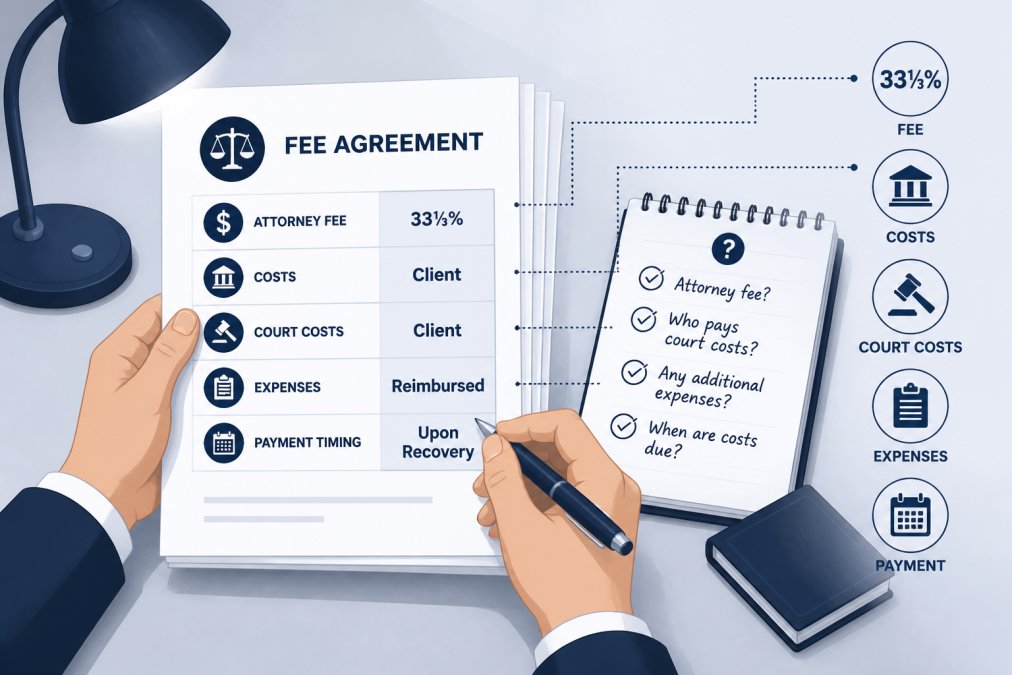
Most fee agreements run several pages and use legal terminology that obscures the practical meaning. Here is a focused checklist for what to look for:
- The fee percentage: Is it calculated on the gross recovery or the net recovery after costs? The difference directly affects your take-home amount.
- Who advances litigation expenses: Does the firm advance costs, or are you expected to contribute during the case?
- What happens to advanced costs if you lose: Are they forgiven, or do you owe them back regardless of outcome?
- Expert witness fees: Are these included in "litigation expenses," or are they treated separately?
- Fee-shifting language: Does the agreement address what happens if a fee-shifting statute applies and the firm recovers fees from the other side?
- Settlement authority: Who has final authority to accept or reject a settlement offer?
The most important clause in any contingency agreement is not the percentage. It’s the sentence that explains what happens to advanced costs if the case does not result in a recovery. That sentence determines your financial exposure if you lose.
According to the American Bar Association’s guidance on contingency fee agreements, written fee agreements that clearly specify the method of fee calculation and the client’s responsibility for costs are a professional requirement in most states. If an attorney cannot or will not explain every line of your fee agreement, that is a meaningful signal about how the rest of the representation will go.
Facing a personal injury or medical malpractice case without understanding the cost structure is a preventable risk. Cummings Law operates on a contingency basis, meaning no attorneys’ fees or court fees are due until the case is resolved, and the firm has obtained over $47,000,000 for clients in recent years across cases including a $15 million settlement and a $10 million settlement. Brian Cummings and the team provide personalized attention and thorough case investigation, so clients understand exactly what they signed and what to expect at every stage. Call for a consultation and get the clarity you need before costs become a surprise.
Frequently Asked Questions
Do you still have to pay your lawyer if you lose?
Under a contingency fee agreement, you do not owe attorney fees if you lose. Your lawyer only gets paid if you recover compensation. However, the agreement may still require you to cover out-of-pocket litigation expenses, such as filing fees, deposition costs, and investigation costs, even when a case is unsuccessful. Always read your specific agreement carefully, because terms vary by firm. Some firms absorb those costs entirely; others do not.
What is the difference between attorney fees and court costs?
Attorney fees are what you pay for your lawyer's time and legal work, typically calculated as a percentage of your recovery under a contingency agreement or billed at an hourly rate. Court costs are separate out-of-pocket expenses: filing fees paid to the court clerk, deposition transcripts, service of process fees, and similar disbursements. In personal injury cases, both categories are usually deducted from a settlement or judgment rather than billed upfront.
Who pays legal fees if you lose a civil lawsuit?
Under the American Rule, each party generally pays its own attorney fees regardless of who wins or loses. The losing party does not automatically owe the winner's legal fees. Exceptions exist under specific federal and state statutory provisions, such as civil rights statutes, or when a contract includes a fee-shifting clause. Court costs like filing fees may be awarded to the prevailing party by court order, but full attorney fee recovery by the adverse party is not automatic.
Are litigation expenses deducted from a settlement?
Yes, in most contingency fee arrangements, litigation expenses accumulated during the case, including expert witness fees, deposition costs, and discovery costs, are deducted from the settlement or judgment before you receive your share. The order of deduction matters: some agreements subtract expenses before calculating the attorney's percentage, while others calculate the fee first. Review your fee agreement closely so you understand your actual net recovery before accepting any settlement offer.
This article was written using GrandRanker