Table of Contents
- Why Evidence Matters in a Car Accident Claim
- Photos to Take After a Car Accident
- Evidence to Prove Fault in a Car Accident
- Medical Evidence for Car Accident Injuries
- Building Your Car Accident Evidence Checklist
- How to Preserve and Organize Your Evidence
- When Evidence Collection Becomes Complicated
- Frequently Asked Questions
Last Updated: October 18, 2026
Why Evidence Matters in a Car Accident Claim
Understanding what evidence is needed for a car accident claim is essential, as strong evidence is the foundation of any successful case. That rarely works. (Source: National Highway Traffic Safety Administration (NHTSA) data)
At Cummings Law, cases that settle quickly and fairly share one trait: solid documentation from day one. Cases that drag on or draw lowball offers lack proof.
Evidence serves three purposes: it establishes what happened, proves who was at fault, and documents the real cost of your injuries and damages.
Start collecting evidence immediately after the accident, even if you’re injured. The first hours matter most, details fade, witnesses leave, and scene conditions change. If you’re unable to document the scene yourself, ask a friend, family member, or bystander to take photos and videos on your behalf.
What you gather now shapes your entire claim: adjusters use it to decide whether to pay, how much, and how fast, and Cummings Law uses it to negotiate the strongest settlement.
Photos to Take After a Car Accident
Photographs are among the most powerful forms of evidence in a car accident claim.
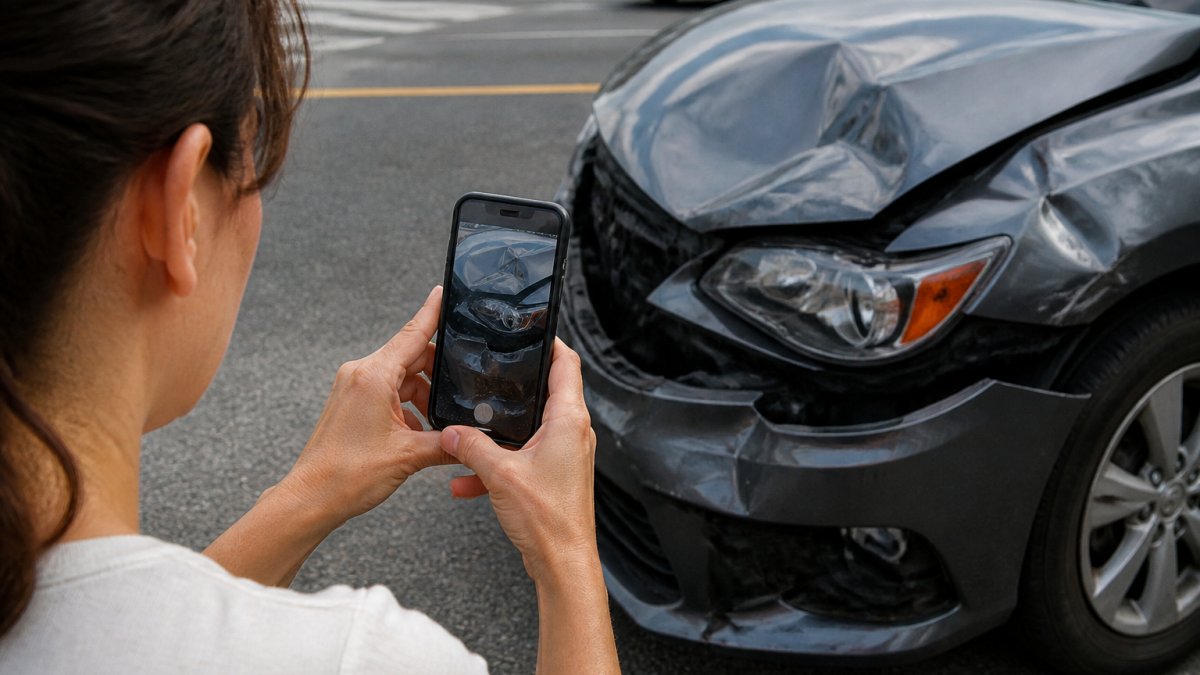
Take photos of the accident scene from multiple angles:
- Wide shots showing the overall scene and vehicle positions
- Close-ups of vehicle damage on all sides
- Skid marks, debris, or other road markings
- Traffic signals, stop signs, and road conditions
Document the other vehicle too: license plate, make, model, color, and the driver’s insurance information and ID if possible.
Photograph your vehicle’s interior, dashboard, steering wheel, and any personal items damaged in the collision, to support property damage claims.
If you’re too injured, ask someone at the scene to take the photos, a witness’s phone images carry the same weight.
Do NOT move vehicles or clean up the scene before photographing everything. Moving vehicles can destroy evidence of skid marks or impact angles. Insurance companies and accident reconstructionists rely on these details to determine fault.
Evidence to Prove Fault in a Car Accident
Proving fault is the most contested part of a claim, and knowing what evidence is needed for a car accident claim to establish liability is critical. Photos show damage, but fault evidence must answer a narrower question: whose conduct caused the collision, and what proof ties it to the crash?
The fault-evidence matrix
Match the evidence to the fault theory you expect the other side to raise.
- Police or official accident report. Answers: what did an independent official observe at the scene? The report captures officer observations, driver and witness statements, citations, and often a preliminary fault determination. Get the report number at the scene, then request the full report through the state’s crash-report portal or the investigating agency’s records division. Reports typically arrive within days to a couple of weeks, and many states charge a small records fee. Note: officers in most states do not make the final legal fault determination, the report is evidence, not a verdict.
- Witness statements. Answers: what did a neutral observer see? Collect full name, phone, email, and, if possible, a short written or recorded statement at the scene. Ask open questions, signal color, speed, phone use, lane position, rather than leading ones. Get the statement in writing the same day; witnesses often become hard to reach.
- Surveillance and traffic camera footage. Answers: what does the video show? Identify every camera with a view of the intersection or road: municipal traffic cameras, red-light cameras, transit cameras, and private security cameras at nearby businesses, gas stations, banks, and homes. Footage is the most perishable evidence in the case, many private systems overwrite within days to a few weeks. Send a written preservation request immediately (see below).
- Event data recorder (EDR) data. Answers: what was the vehicle doing in the seconds before impact? Most vehicles built since the mid-2010s record pre-crash speed, braking, throttle, and steering input. The data belongs to the vehicle owner, and retrieval generally requires consent, a court order, or a discovery request, which is why an attorney is often needed to obtain it before the vehicle is repaired or sold. Do not let the vehicle be repaired, salvaged, or traded in before the data is imaged.
How fault is actually decided
Most states use one of two frameworks. Under pure comparative fault, your recovery is reduced by your share of fault but you can still recover. Under modified comparative fault, recovery is barred once your share reaches a threshold (commonly 50% or 51%). A few states still use contributory negligence, which can bar recovery entirely. Because the threshold is state-specific, the evidence that matters most is whatever rebuts the other driver’s claim that you contributed, speed data, signal evidence, and witness accounts of lane position or phone use.
The strongest fault case layers independent sources: an official report, a neutral witness statement, and either video or EDR data. When those three agree, adjusters rarely fight liability. When they conflict, the video and vehicle data usually decide it, which is why preserving them early matters more than collecting more photos later.
Medical Evidence for Car Accident Injuries
Medical records prove your injuries resulted from the accident, and insurers scrutinize that connection. A gap between the crash date and your first medical visit raises causation questions.
Seek medical attention immediately, even if you feel fine, some injuries appear hours or days later.
Collect and organize your medical documentation:
- Emergency room records and discharge summaries
- Diagnostic imaging (X-rays, MRI, CT scans)
- Doctor’s clinical notes and treatment plans
- Physical therapy records and progress notes
Medical bills prove the financial cost of your injuries and drive claim value. Keep every receipt, invoice, and statement related to your treatment. (Source: U.S. Department of Transportation’s Federal Motor Carrier Safety Administration (FMCSA) regulations)
Document ongoing symptoms and limitations in a journal covering pain levels, mobility restrictions, and effects on daily life. This subjective evidence complements the objective records.
Building Your Car Accident Evidence Checklist
Organizing your evidence strengthens your claim and speeds settlement. Use this checklist:
- Police or accident report with report number
- Photos and videos from the scene
- Photos of vehicle damage (all angles)
- Photos of your injuries
- Witness names, phone numbers, and statements
The more complete your checklist, the stronger your negotiating position, insurers read thorough documentation as a serious claim.
How to Preserve and Organize Your Evidence
Collection is only half the job. Evidence that is overwritten, deleted, repaired away, or left unauthenticated can be excluded or discounted. Here’s how to preserve and organize what you gather so it holds up.
Preservation timeline: what to request, and when
Treat preservation as a countdown. The clock starts the day of the crash.
- Day 0-3: private and municipal video. Send written preservation requests to every business, homeowner, transit agency, and municipality with a camera that could have captured the crash. Private systems commonly overwrite within days to a few weeks; do not wait for the police report to identify them. Keep a copy of every request and note the date sent.
- Day 0-7: your own digital evidence. Upload phone photos and videos to cloud storage the same day. Do not edit, crop, or apply filters, keep the original files with their metadata intact. If you have a dashcam, remove the memory card or export the clip before it loops over.
- Day 0-14: the vehicle and its data. Do not authorize repairs, salvage, or sale of either vehicle until EDR data is imaged and damage is photographed. Body shops routinely disassemble and repair vehicles quickly; once that happens, physical evidence is gone.
- Day 0-30: medical and treatment records. Request records and bills from every provider as treatment occurs. A gap between the crash date and first treatment is one of the most common reasons adjusters dispute causation.
- Ongoing: witness contact. Confirm witness contact information within the first week and follow up in writing. Witnesses move, change numbers, and become unavailable.
Sending a preservation (spoliation) letter
A preservation letter, or spoliation letter, is a written demand that a party or third party keep evidence relevant to a potential claim. It puts the recipient on notice and creates a record that can support sanctions if evidence is later destroyed. A practical letter identifies the crash date, time, and location; describes the evidence (for example, “all surveillance video from cameras covering the intersection of ___ for the period 6:00-8:00 p.m. on ___”); demands preservation in its original format; and asks for written confirmation.
Do not rely on a phone call or a verbal promise that footage will be “held.” Without a written request and proof of delivery, a business or agency may have no duty to preserve anything, and the footage may be gone before anyone follows up.
Authenticating and organizing what you collect
Evidence is only as useful as it is credible. Follow these practices so your file survives scrutiny.
- Keep originals. Preserve original files and paper documents. Make working copies for review, but never overwrite or “clean up” the originals.
- Record the source and date of everything. For each item, note who took it, when, where, and how it was obtained. A photo with no provenance is easy to challenge.
- Maintain a simple evidence log. A one-page spreadsheet with columns for date received, description, source, format, and storage location turns a shoebox of records into a file an attorney or adjuster can work with immediately.
- Back up in more than one place. Cloud storage plus a local drive protects against device loss or failure. Do not store the only copy on a phone.
- Keep a symptom and treatment journal. Date every entry. Subjective records complement objective medical documentation and help establish the full impact of injuries.
Do not post about the crash on social media, and do not accept friend requests or messages from people you do not recognize after filing a claim. Insurers routinely review public posts, and statements made online can be used to contradict your claim. Keep case details private until the matter is resolved.
When Evidence Collection Becomes Complicated
Some accidents make evidence gathering harder. Understanding these scenarios helps you protect your rights.
In hit-and-run accidents, you rely on witness and vehicle descriptions and traffic camera footage.
With three or more vehicles, determining who caused the initial collision is critical.
Building a strong case starts with evidence.
At Cummings Law, we guide you through every step of this process.
Frequently Asked Questions
Can I file a car accident claim without a police report?
Yes, you can file a claim without a police report, but having one strengthens your case significantly. Police reports provide an official, neutral account of the accident and often include the officer’s assessment of fault. If police did not respond to your accident, gather as much other evidence as possible: witness statements, photographs, medical records, and repair estimates. Your insurance company and any legal representation will work with whatever documentation you have, but a police report eliminates doubt about what happened.
What should I do if I don’t have enough evidence for my car accident claim?
If your evidence is incomplete, act quickly to preserve what remains. Contact witnesses before they disappear; reach out to local businesses that may have security footage; request your vehicle’s event data recorder information from the manufacturer; and obtain copies of your medical records immediately. An experienced attorney can also file evidence preservation requests with the other driver’s insurance company or their attorney, legally requiring them to retain dashcam footage, phone records, and other materials. The sooner you secure legal help, the more evidence your team can recover before it’s lost.
How can medical records support a car accident injury claim?
Medical records create a documented chain linking your injuries directly to the collision. Emergency room notes, diagnostic imaging (X-rays, MRI), treatment plans, and follow-up visits all show when symptoms began, how serious they were, and what care was necessary. Insurers and courts use these records to understand the extent of your injuries and calculate fair compensation for medical bills, ongoing treatment, and pain and suffering. Obtain complete records from every provider involved in your care, including hospitals, specialists, and physical therapists, and organize them chronologically to show the progression of your recovery.
What evidence helps prove who was at fault in a car accident?
Proof of fault comes from multiple sources: photographs showing vehicle positions, skid marks, and road conditions; witness statements describing what each driver did; police reports with officer observations; traffic law violations (running a red light, speeding, failure to yield); vehicle damage patterns indicating direction of impact; and event data recorder information showing speed and braking. Your attorney will analyze this evidence to establish liability. In some cases, accident reconstruction experts examine the physical evidence and provide technical analysis. The stronger your evidence collection, the clearer the picture of how the accident occurred and who caused it.