Table of Contents
- Understanding the Four Elements of Negligence
- Key Evidence to Collect After Your Fall
- The Importance of Surveillance Footage
- Slip and Fall Evidence Checklist
- Constructive Notice vs. Actual Notice
- Slip and Fall Statute of Limitations
- Comparative Negligence and Your Recovery
- Building Your Case: Documentation and Medical Records
- Frequently Asked Questions
Last Updated: September 3, 2026
Understanding the Four Elements of Negligence
To prove negligence in slip and fall cases, you must establish four distinct legal elements. Each is essential; failing to prove even one will likely defeat your case. This framework applies across all premises liability claims.
Duty of Care Explained
Property owners have a legal obligation to maintain their premises in a reasonably safe condition for visitors. This duty extends to customers, employees, and in many cases trespassers, though the level of care varies by visitor type. The duty requires owners to either fix hazardous conditions, warn visitors about them, or inspect regularly to catch problems before injury occurs.
Courts determine whether a duty existed by examining the relationship between you and the property owner. A business owes a higher duty to paying customers than to someone wandering onto private property uninvited. According to the National Safety Council, slip, trip, and fall injuries account for significant workplace and public space incidents, underscoring why property owners have this fundamental duty. Establishing duty is rarely the difficult part of a slip and fall case; the real challenge comes next.
Breach of Duty
Breach of duty means the property owner failed to uphold that standard of care. They either created the hazard, knew about it and did nothing, or should have known about it through reasonable inspection.
There are two ways to prove breach: actual notice and constructive notice. Actual notice means the property owner directly knew about the hazard, an employee saw the spill or a customer reported it. Constructive notice means the hazard existed long enough that a reasonable inspection should have uncovered it. If a wet floor sat unattended for hours, the property owner should have found it during normal maintenance checks.
You must show that the property owner’s actions or inaction fell below what a reasonable property owner would do. This requires evidence like cleaning schedules, maintenance logs, and testimony about inspection frequency. Without such evidence, you’re left arguing the owner “should have known,” a much weaker position.
Causation and Damages
Causation means your fall was directly caused by the breach of duty, you slipped because of the wet floor the owner failed to clean, not due to inattention. This requires medical evidence linking your injuries to the fall itself.
Damages are the measurable harms you suffered: medical bills, lost wages, pain and suffering, and ongoing care costs. According to the National Safety Council, the average cost for all claims combined for accidents that occurred in 2021-2022 was $44,179, though severe cases can far exceed this figure. You must document every expense and every impact on your life. Courts won’t award damages for injuries you cannot prove came from this specific fall.
Key Evidence to Collect After Your Fall
The evidence you gather in the hours and days after your fall determines whether you can prove negligence. Many people leave the scene without collecting what they need, then struggle to reconstruct it weeks later.
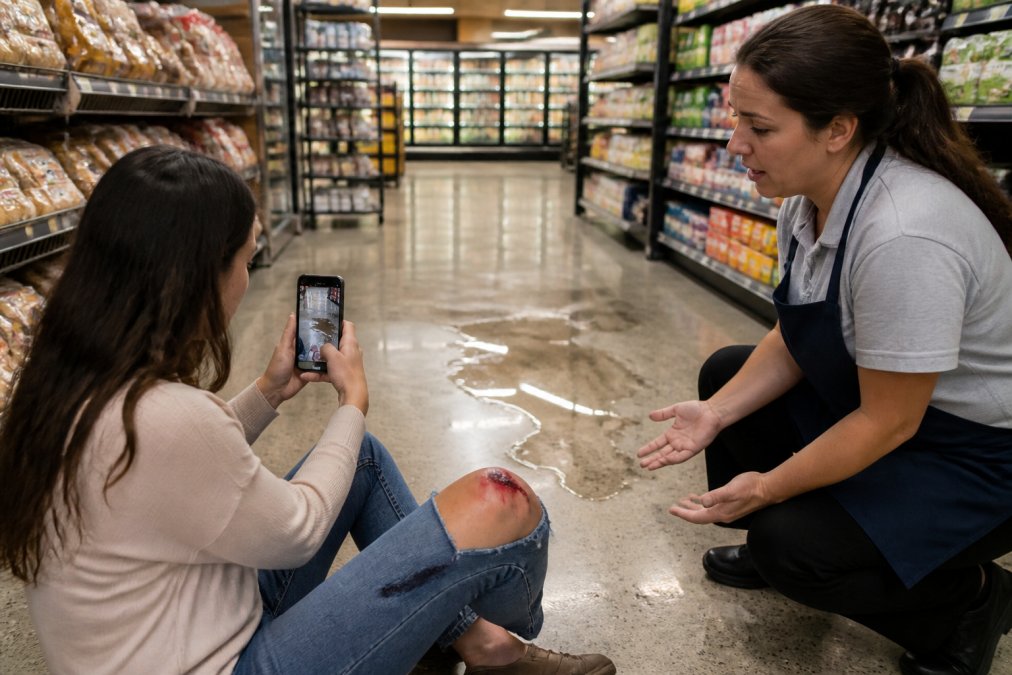
Start by photographing the exact spot where you fell. Capture the hazard from multiple angles, close-ups of the wet surface or debris, and wider shots showing the location within the store or property. Take photos of your injuries immediately, then again over the following days as bruises develop.
Get witness information from anyone who saw you fall or the hazard beforehand. Write down their names, phone numbers, and observations. Witnesses provide independent corroboration of what happened.
Request an incident report from the property owner or manager. Many businesses must document accidents on their premises. If the report acknowledges the hazard or notes delayed cleanup, it’s powerful evidence. If the owner refuses to provide it, that refusal itself can suggest negligence.
Preserve any physical evidence. If your clothing was damaged or stained by the substance you slipped on, keep it. Document any product involved in the fall.
The Importance of Surveillance Footage
Surveillance footage is often the single most decisive piece of evidence in a slip and fall case. It shows exactly what happened, how long the hazard existed, and whether the property owner had time to address it.
Request surveillance footage immediately. Most businesses retain security camera recordings for 30 to 90 days (osha.gov). Send a formal written request to the property manager or owner; if they refuse, your attorney can subpoena it. Be aware that some businesses claim footage was deleted or cameras don’t cover certain areas, this is where spoliation of evidence becomes relevant.
Spoliation of evidence occurs when a party destroys or fails to preserve evidence they know will be needed in litigation. If a business deletes the footage from the exact time and location of your fall, that deletion itself becomes evidence of negligence. Courts take spoliation seriously and may impose sanctions or allow the jury to assume the missing footage would have supported your case. avoiding parking lot liability.
The footage should show how long the hazard remained unaddressed. If it shows employees walking past the spill multiple times without cleaning it, that’s powerful proof of breach of duty.
Slip and Fall Evidence Checklist
Organizing your evidence into a clear checklist ensures you don’t miss critical items.
| Evidence Type | What to Collect | Why It Matters |
|---|---|---|
| Scene Photos | Multiple angles of hazard, wider location shots | Proves hazard existed and its location |
| Injury Photos | Immediate and progression over days | Documents injury severity and timeline |
| Witness Info | Names, contact details, what they saw | Provides independent corroboration |
| Incident Report | Property owner’s formal accident documentation | May acknowledge hazard or delayed response |
| Medical Records | ER visit, diagnosis, treatment, follow-up care | Establishes causation and damages |
| Receipts & Bills | Medical expenses, prescription costs, lost wages | Quantifies financial damages |
| Surveillance Footage | Video from time of fall and before | Shows hazard duration and owner’s notice |
| Maintenance Logs | Cleaning schedules, inspection records | Proves or disproves reasonable inspection |
| Expert Reports | Medical, engineering, or safety analysis | Strengthens causation and breach claims |
The more boxes you can check, the stronger your position when negotiating a settlement or presenting your case to a jury.
Constructive Notice vs. Actual Notice
Actual notice means the property owner or an employee directly observed the hazard. A manager saw the spill or a customer reported it. Actual notice is straightforward to prove.
Constructive notice means the hazard existed long enough that a reasonable property owner, through regular inspection, should have discovered it. You’re not claiming they actually saw it; you’re claiming they should have. This requires evidence about inspection frequency, maintenance schedules, and how long the hazard likely existed.
Courts apply a “reasonable inspection” standard. If a retail store typically sweeps its aisles every 30 minutes but a spill sat for two hours, constructive notice likely applies. The key is establishing what “reasonable” inspection looks like for that particular property.
Digital evidence increasingly helps establish constructive notice. Timestamped cleaning logs, electronic maintenance records, and security system timestamps prove how long a hazard went unaddressed. The absence of such records suggests the owner wasn’t conducting reasonable inspections at all.
Slip and Fall Statute of Limitations
Each state sets a deadline, called the statute of limitations, for filing a lawsuit. Miss that deadline and you lose your right to sue entirely, regardless of how strong your case is.
In Hawaii, the statute of limitations for slip and fall cases is generally two years from the date of your injury. However, you should not wait years to file. Evidence degrades, witnesses move away, memories fade, and surveillance footage gets deleted. The sooner you act, the stronger your case will be.
Cummings Law recommends consulting with an attorney within weeks of your injury. An early consultation doesn’t obligate you to file suit immediately, but it preserves your options and ensures evidence is preserved. Your attorney can send a preservation letter to the property owner, legally requiring them to maintain all evidence related to your fall.
Comparative Negligence and Your Recovery
Hawaii follows a modified comparative negligence rule, which allows you to recover even if you were partially at fault, as long as your share of fault does not exceed 50%. If you are found to be 51% or more at fault, you will be barred from recovering any damages. If you were 20% at fault and the property owner was 80% at fault, you can recover 80% of your damages. If your total damages are $100,000, you’d receive $80,000.
The property owner’s insurance company will argue that you were careless or inattentive. Your attorney must counter this by focusing on the property owner’s duty and breach. Even if you were somewhat inattentive, the property owner’s failure to maintain a safe environment is still negligence.
Building Your Case: Documentation and Medical Records
Your medical records are the backbone of your damages claim. They prove you were injured, document the severity, and establish the connection between the fall and your injuries.
Seek immediate medical attention after your fall, even if you feel okay. Some injuries develop over hours or days. An emergency room visit creates an official record with a timestamp, medical findings, and initial treatment. Follow up with your primary care physician and any specialists recommended. Keep every receipt, bill, and explanation of benefits.
Document your recovery process. If you miss work, get written confirmation from your employer. If you require ongoing physical therapy, keep attendance records. If your injuries prevent you from activities you previously enjoyed, document that impact.
Organize all documentation chronologically. Medical records should flow from the initial ER visit through current treatment. Bills should be itemized and totaled. Wage loss should be calculated with pay stubs and employer verification. Clear, organized documentation is far more persuasive than scattered records.
Cummings Law has recovered over $47,000,000 for clients in recent years by building cases on this foundation of solid evidence and documentation. Cases like a $15 million settlement for a slip and fall with clear surveillance footage demonstrate the power of thorough evidence collection and strategic case building.
Proving negligence in a slip and fall case requires patience, organization, and evidence. Insurance companies will challenge your claim at every step. You need an attorney who understands how to gather evidence, establish constructive notice, and present your case compellingly. At Cummings Law, we’ve spent years helping injured people navigate these complex claims and recover the compensation they deserve. Call for a consultation today, and let us investigate your case with the thoroughness it requires.
Frequently Asked Questions
Q: What are the four elements of negligence in a slip and fall case?
A: To prove negligence in slip and fall cases, you must establish four elements: (1) the property owner owed you a duty of care, (2) they breached that duty by failing to maintain safe conditions or warn of hazards, (3) this breach directly caused your fall and injuries, and (4) you suffered measurable damages. Each element must be proven with evidence such as surveillance footage, medical records, and witness testimony. Without all four, your claim may fail.
Q: How do you prove a property owner knew about a hazard?
A: You can prove knowledge through actual notice (direct evidence the owner knew about the hazard) or constructive notice (evidence the hazard existed long enough that a reasonable inspection would have discovered it). Surveillance footage showing how long a spill remained unattended, cleaning schedules, prior complaints, maintenance logs, and witness statements all demonstrate knowledge. Digital inspection records and timestamps are increasingly important in establishing that the owner should have known about the danger.
Q: What is the statute of limitations for slip and fall cases?
A: In Hawaii, the statute of limitations for personal injury claims, including slip and fall cases, is generally two years from the date of injury. This means you have two years to file a lawsuit. However, certain circumstances may extend or shorten this deadline. It’s critical to act quickly and consult with an attorney early, as waiting too long can bar your claim entirely, regardless of its merit.
Q: How does comparative negligence affect my slip and fall settlement?
A: Hawaii follows comparative negligence rules, meaning you can recover compensation even if you share partial responsibility for the fall, as long as your share of fault does not exceed 50%. If you are found to be 51% or more at fault, you will be barred from recovering any damages. If you were 20% at fault and your damages total $100,000, you would recover $80,000. This makes evidence of the property owner’s negligence and your own reasonable conduct critical to maximizing your settlement.
This article was written using GrandRanker