Last Updated: November 7, 2026
Quick Summary
A hit and run claim does not automatically raise your car insurance premium. Whether your rate goes up depends on who was at fault, what coverage you use, and how your insurer evaluates risk. Fault matters more than the claim itself, and a not-at-fault accident is less likely to raise your rate.
- An at-fault accident increase typically lasts three to five years, while Allstate reports an average of three years.
- File a police report as soon as possible and ask for the report number before leaving the scene.
- Collision coverage pays to repair your car after a hit and run, minus your deductible.
- Most hit and run claims take weeks to a few months, not days, especially when the other driver is never found.
- Ask about accident forgiveness and check state protections that may restrict surcharges on not-at-fault claims.
Table of Contents
- Will a Hit and Run Claim Raise My Insurance?
- What to Do After a Hit and Run: A Step-by-Step Claims Checklist
- Hit and Run Insurance Claim Without a Police Report
- Does Insurance Cover a Hit-Run Parked Car?
- How Long Does a Hit-and-Run Insurance Claim Take?
- The Factors Behind a Premium Change
- How to Challenge an Incorrect Fault Decision and Reduce Costs
- When to Bring in a Hit-Run Attorney
- Frequently Asked Questions
Will a Hit and Run Claim Raise My Insurance?
A hit and run claim does not automatically raise your car insurance premium. The answer is rarely a simple yes or no. (Source: The National Highway Traffic Safety Administration (NHTSA) reports that in 2022, there were 1,011 fatalities in hit-and-run crashes, a 3.1% increase from 2021)
Here is the key point most drivers miss: fault matters more than the claim itself.
Progressive notes that a premium may not increase when the driver was not at fault, though it also warns that some insurers may raise rates after any accident (EXTERNAL_LINK: Progressive on hit and run claims and coverage | progressive.com).
How Fault Determination Drives the Outcome
Fault determination is the process an insurer uses to decide who caused a crash. That decision shapes your claim history and your future risk. A not-at-fault accident is less likely to raise your rate. GEICO says some insurers may still raise rates even when you did nothing wrong (EXTERNAL_LINK: GEICO on rate changes after a claim | geico.com).
So the real question is not “did I file a claim?” It is “will my insurer record me as responsible?”
At-Fault vs. Not-at-Fault Accidents
An at-fault accident means you caused the crash. A not-at-fault accident means someone else did. The two carry very different weight.
An at-fault accident can follow you for years. GEICO says an increase after an at-fault accident typically lasts three to five years, while Allstate reports an average of three years (EXTERNAL_LINK: GEICO on how long accidents affect rates | geico.com).
What to Do After a Hit and Run: A Step-by-Step Claims Checklist
Move fast and document everything. The steps you take in the first hour shape the whole claim, and the quality of your documentation often matters more than the size of the dent.
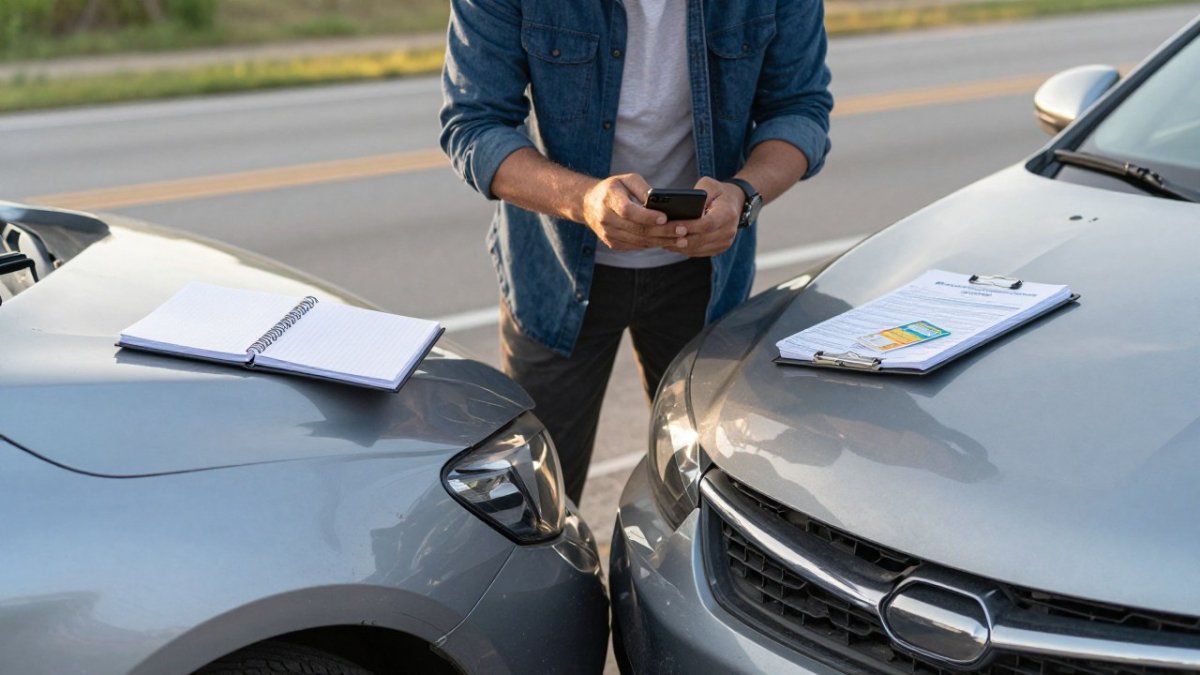
The First Hour: Safety and Evidence
- Stop and check for injuries. Call 911 if anyone is hurt. Leaving the scene of an injury crash can carry criminal exposure under state law, even when the other driver fled first.
- Move to a safe spot and turn on your hazards. Get out of travel lanes before you do anything else.
- Photograph everything before you move the car if it is safe to do so. Capture wide shots of the scene, close-ups of damage, the position of your vehicle, road markings, traffic signals, and any debris or paint transfer.
- Write down the time, location, and direction the other car fled. Note the make, model, color, and any partial plate. Even two characters of a plate can help police.
- Look for witnesses and collect names and phone numbers. Ask whether anyone saw the impact or captured it on a dashcam. Witness statements are often the difference between a clean not-at-fault finding and a disputed one.
- File a police report as soon as possible. Ask for the report number before you leave the scene. Many insurers expect prompt reporting, and some states set reporting deadlines, so check your state’s rules.
The First 24 to 72 Hours: Notifying Your Insurer
- Call your insurer and open a claim. Tell the adjuster plainly that the other driver fled and that you are claiming under your own coverage. Ask which coverage will be applied, collision, uninsured motorist property damage, or medical payments, and what your deductible will be.
- Send a written follow-up. Email or message the adjuster a short summary of the facts, the police report number, and copies of your photos. A written record prevents later disputes about what you reported and when.
- Keep the damaged parts. Do not authorize repairs before the adjuster inspects the vehicle or waives inspection in writing.
Building a Claim File That Survives Scrutiny
A hit-and-run claim is essentially a claim against your own policy, so the burden of proof falls on you. Build a file that answers the questions an adjuster will ask:
- Proof the crash happened: police report, photos, witness contacts, dashcam footage.
- Proof of the other driver’s flight: the police report narrative, your written statement, witness statements.
- Proof of loss: repair estimates from at least two shops, medical records and bills if anyone was hurt, and receipts for a rental car or towing.
Watch out: If you cannot file a report immediately, note in writing why, and file as soon as you can.
For the broader sequence of steps after any crash, see our guide on 7 steps to take after a car accident in Hawaii 2026.
Hit and Run Insurance Claim Without a Police Report
You can still file a hit and run insurance claim without a police report, but the claim is weaker.
Some insurers require prompt reporting to police. Others accept a statement and photos. Call your insurer and ask what it needs. Then file the report anyway, even if it is late.
To understand how a police report feeds into a claim, read our page on Hawaii police report insurance claims.
Does Insurance Cover a Hit-Run Parked Car?
Yes, a hit-and-run parked car is usually covered, but the coverage that pays depends on your policy. If you carry collision coverage, it typically pays to repair your car, minus your deductible. If you carry uninsured motorist coverage for property damage, that may apply too.
Collision, Uninsured Motorist, and Deductibles
Collision coverage pays to fix your own car after a crash, no matter who caused it. You pay the deductible first.
Uninsured motorist coverage applies when the at-fault driver has no insurance or cannot be found. Hit-and-run drivers usually fall into that second group.
Your deductible is the amount you pay out of pocket before insurance kicks in. Choosing a higher deductible lowers your premium but raises your out-of-pocket costs at claim time (Understanding your insurance deductibles).
How Long Does a Hit-and-Run Insurance Claim Take?
Most hit-and-run claims take weeks to a few months, not days. Timelines stretch when the other driver is never found, because your insurer must confirm the facts before it pays.
Expect longer waits if:
- There is no police report
- Damage is disputed
- Injury claims are involved
Keep copies of every document. Follow up in writing. A paper trail keeps the claim moving.
The Factors Behind a Premium Change
Insurers weigh several factors when they set your rate after a claim. No single one decides it, and the same crash can produce different outcomes for two drivers with different histories and coverage. The table below shows what each factor does, and, more importantly, how it interacts with the others.
| Factor | What It Means | Typical Effect |
|---|---|---|
| Fault | Who caused the crash | Not-at-fault often means no increase, but not always |
| Claim history | Past claims on your record | Multiple claims raise risk faster than one |
| Coverage used | Collision vs. uninsured motorist | Some claim types weigh more heavily |
| Driving record | Tickets and violations | Compounds the effect of a claim |
| State rules | Local insurance regulations | Can limit or prohibit rate increases |
| Renewal timing | When the claim lands relative to your policy term | Can delay or split the impact |
The Consumer Federation of America found that some drivers faced higher premiums after not-at-fault accidents, including an average $208 increase for moderate-income drivers and an average 6.6% penalty for higher-income drivers (EXTERNAL_LINK: Consumer Federation of America on not-at-fault premium increases | consumerfed.org) (Article – Major Insurance Companies Raise Premiums After Not-At-Fault Accidents).
How the Factors Interact
A single factor rarely tells the whole story. Because insurers weigh claim history and driving records together, understanding what can drive premium increases helps explain why similar hit-and-run claims may affect renewal rates differently, as Haneyfarmbureau notes.
Coverage type matters too. A collision claim pays to repair your car regardless of fault, and some insurers treat it as a claim on your record even when you were not responsible.
Claim Payment vs. Premium Impact: A Worked Example
These are two separate decisions, and confusing them is one of the most common sources of frustration after a hit-and-run.
Consider a driver with a $500 collision deductible and $4,000 in damage from a hit-and-run. The insurer pays $3,500 after the deductible.
Now consider the same crash where the driver carries no collision coverage but does carry uninsured motorist property damage coverage with a $250 deductible.
Levers That Can Reduce the Impact
- Ask about accident forgiveness. Many insurers offer it as an optional add-on or as a loyalty benefit. Confirm whether it applies to not-at-fault claims and how long it stays on your policy.
- Check state protections. Some states restrict how insurers can use not-at-fault claims in rating, so check your state’s rules. Ask your insurer or state insurance department whether a not-at-fault hit-and-run claim can be surcharged.
- Review the renewal, not just the claim. The premium change appears at renewal, so compare the declarations page before and after the claim rather than assuming the claim caused the difference.
Watch out: Do not assume that because the other driver was at fault, your rate is protected. Confirm in writing how the claim will be recorded and whether it will be used in rating at your next renewal.
How to Challenge an Incorrect Fault Decision and Reduce Costs
You can push back when your insurer gets fault wrong. Start by requesting the fault determination in writing. Then send your evidence: photos, the police report, witness statements, and any dashcam footage.
Ask your insurer to review the decision. If it refuses, ask about its formal appeal process. Keep every message.
Ways to reduce costs:
- Raise your deductible only if you can cover it
- Ask about accident forgiveness if you qualify
- Keep a clean driving record going forward
Mistakes during settlement talks can shrink your payout. Our guide on hit and run settlement negotiation mistakes covers what to avoid.
When to Bring in a Hit-Run Attorney
Bring in a hit run attorney when injuries are serious, fault is disputed, or the insurer denies or underpays your claim.
Watch out: insurers move fast on early settlement offers.
If a claim is denied, our page on injury claim denial and what to do next explains your options. And if you are unsure whether you need counsel at all, read do I need a lawyer for a car accident?
Cummings Law works on a contingency basis, so you pay no attorneys’ fees or court fees until your case is complete.
A hit-and-run crash leaves you shaken and facing a claims process built to test your patience.
Frequently Asked Questions
Does filing a hit-and-run claim affect your rates if you were not at fault?
Not automatically. A not-at-fault accident is less likely to increase your premium, but some insurers may still raise rates after any accident, and some drivers do face higher premiums after not-at-fault claims. Your claim history and insurer practices both matter, so ask your provider how a not-at-fault claim is treated before you file.
Can I file a hit-and-run insurance claim without a police report?
Many insurers will still open a claim without a police report, but the report is often the strongest evidence that the other driver left the scene and that you were not at fault. Without it, your claims adjuster may rely more heavily on photos, witness statements, and your own account, which can slow the process or complicate fault determination. Filing a report promptly also protects you if the unidentified driver is later located. If you could not file one immediately, do it as soon as possible and give your insurer the report number.
Does insurance cover a hit-and-run involving a parked car?
It depends on which coverage you carry. Collision coverage typically pays for damage to your own vehicle, including a hit-and-run while parked, and you pay your deductible. Uninsured motorist coverage may also apply in some states and policies. Liability coverage does not pay for your own car. If you only carry liability insurance, repairs usually come out of your own pocket. Check your policy’s coverage limits and deductible before filing so you know the out-of-pocket costs.
How long does a hit-and-run insurance claim take to resolve?
There is no fixed timeline. A straightforward claim with clear evidence, a police report, and an identified at-fault driver may resolve in a few weeks. Claims involving an unidentified driver, disputed fault, or uninsured motorist coverage often take longer because your insurer must verify the facts before paying. Repair costs and damage assessment add time if your car needs a shop estimate. Ask your claims adjuster for a status update and keep copies of every document you send.